
Más publicaciones
AI chatbots for business: differences


AI chatbots for business: differences, benefits, and limitations compared to traditional bots and AI agents.
A business AI chatbot is not the same as a traditional chatbot. It is also not exactly the same as an AI agent.
Although all three can be part of a conversational automation strategy, each plays a distinct role within your operations.
A traditional chatbot helps organize simple conversations.
An AI chatbot better interprets what the user is trying to say.
An AI agent can go further: making decisions, querying systems, and executing actions connected to your business.
That is why, before choosing a solution, it is important to understand the difference. Not every company needs the same level of automation, but they do need clarity to avoid investing in a tool that falls short or complicates the user experience. 🤖

What is a traditional chatbot
A traditional chatbot works with rules, buttons, menus, and predefined responses.
Typically, the user must follow a specific path:
- choose an option
- respond with a keyword
- navigate a menu
- select a category
- wait for a pre-configured response
This type of chatbot can be useful for simple, repetitive processes. For example: sharing business hours, sending a location, answering frequently asked questions, or directing the user to the right department.
However, its main limitation appears when the conversation goes off the expected path.
If the user types a different question, combines several inquiries, or uses natural language, the bot may not understand. In those cases, the experience becomes rigid.
If your company is still in the stage of understanding the conversational basics, you can check out this guide on what a business chatbot is.

What is an AI chatbot for business
An AI chatbot for business uses artificial intelligence to better interpret user messages.
Unlike a traditional chatbot, it does not rely solely on closed menus.
It can understand natural language, detect intent, and provide more flexible responses.
For example, if a user writes:
“I want to know if I can pay for my order via WhatsApp and when it will arrive”
A traditional chatbot might get lost if that phrase isn't part of its pre-set flow. In contrast, an AI-powered chatbot can identify multiple intents: payment, order, channel, and delivery.
This allows for a more natural conversation, especially on channels like WhatsApp, webchat, or social media.
That is why WhatsApp chatbots for business become more useful when they combine automation, AI, and clear business rules.
If your current chatbot relies too heavily on menus, your company might need a more flexible experience powered by AI.

AI chatbot vs. traditional chatbot
The main difference lies in flexibility.
1. How they understand the user
A traditional chatbot recognizes options.
An AI chatbot interprets intent.
This means users can type more naturally, without having to adapt so much to the menu.
2. Conversation type
Traditional chatbots work well for closed flows.
AI chatbots work better for open conversations.
For example, in sales, support, or customer service, users don't always ask the same way. AI helps manage that variation.
3. Customer experience
A traditional chatbot can feel mechanical.
An AI chatbot can feel more fluid and contextual.
This doesn't mean it's always perfect. But it does help reduce friction when the conversation requires more interpretation.
4. Level of control
A traditional chatbot is more predictable.
An AI chatbot requires better design, training, boundaries, and supervision.
That is why a good implementation isn't just about "turning on AI" and expecting results. It requires strategy, data, flows, and clear criteria.
AI chatbot vs. AI agent
Here is the most important difference.
An AI chatbot for businesses can better understand and respond. But an AI agent can execute with more autonomy.
The comparison looks like this:
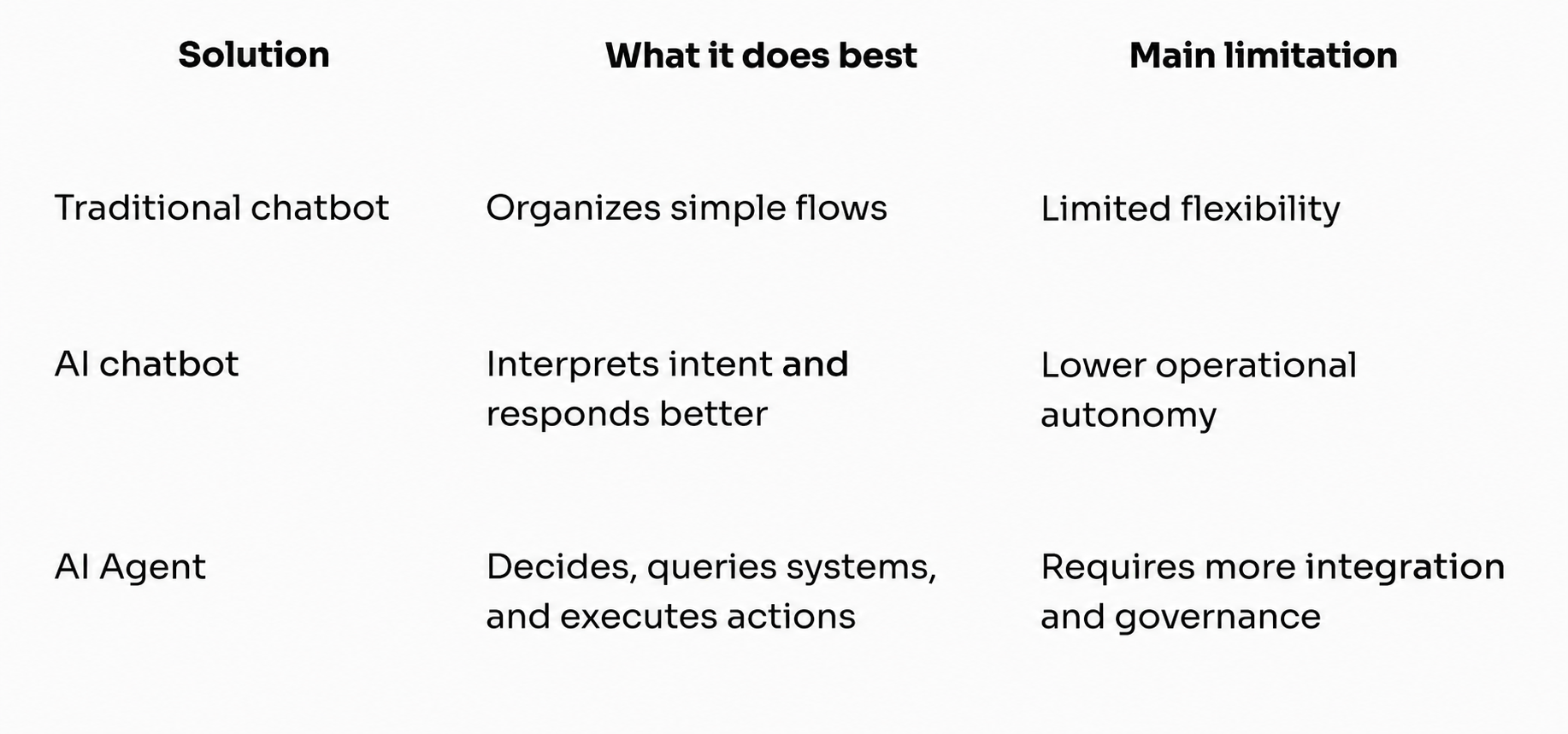
An AI chatbot can tell the user what to do.
An AI agent can help them do it.
For example, in sales, an AI chatbot can answer questions and guide the prospect. But an AI agent can qualify the lead, update the CRM, trigger follow-ups, and escalate to the sales team.
To dive deeper into this operational side, you can read the article on AI agents in sales.

When to use a traditional chatbot
A traditional chatbot may be sufficient when:
- the process is simple
- the questions are highly repetitive
- the user must follow fixed steps
- little personalization is needed
- there is no deep system integration
For example, it can work for schedules, locations, FAQs, or department selection.
In these cases, advanced AI is not always necessary.
When to use an AI chatbot for business
An AI chatbot for business is a good fit when the conversation requires more context.
It is useful when:
- users ask questions in many different ways
- there are multiple product or service lines
- you need to detect commercial intent
- WhatsApp is a key channel
- the team receives many repetitive inquiries
- you want to improve support without sacrificing speed
- sales needs better-qualified leads
It can also be a good transition between a traditional bot and a more advanced solution using AI agents.
Within a strategy of artificial intelligence for sales, the AI chatbot acts as a layer to provide better responses, filter conversations, and prepare sales opportunities.
When to use AI agents
AI agents are best suited for when a company needs execution, not just conversation.
For example:
- querying information in systems
- updating records
- automated follow-ups
- lead qualification
- triggering workflows
- escalating cases with context
- connecting support, sales, and operations
In these cases, the company needs a more robust architecture. That is where an enterprise AI platform allows you to connect channels, agents, data, human teams, and integrations in a single environment.
If your company wants to do more than just answer messages and is ready to advance processes, it is time to think beyond the chatbot.
Common mistakes when choosing an AI chatbot
Some companies adopt an AI chatbot without defining the problem they want to solve.
The most common mistakes are:
- choosing AI when only a simple flow is needed
- using generic responses without business context
- not defining when to escalate to humans
- not connecting data or CRM
- not measuring resolution, conversion, or satisfaction
- expecting AI to fix a poorly designed process
An AI chatbot works best when it has a clear function: improving the conversation, reducing friction, and preparing for the next step.
Conclusion
An AI chatbot for businesses is more flexible than a traditional chatbot because it can interpret natural language, detect intent, and respond with more context.
However, it is less autonomous than an AI agent because it typically does not execute complex processes on its own or make deep operational decisions without additional integration.
The key is to choose the right solution based on your company's level of maturity:
- traditional chatbot for simple flows
- AI chatbot for more flexible conversations
- AI agent for connected processes and execution
At Nerds.ai we help companies design AI-powered conversational experiences for customer service, sales, and operations.
With AI Marketing & Sales and the Nerds.ai platform, your company can connect chatbots, agents, workflows, and data to move from automated conversations to intelligent processes.
Explore more content on the Nerds.ai blog or let's talk about the type of automation your company needs.


