
Más publicaciones
.png)
.png)
WhatsApp Business Platform: pricing changes


Meta is updating WhatsApp Business Platform pricing starting in October 2026. Learn what is changing and how to prepare.
WhatsApp Business Platform: Meta changes WhatsApp channel pricing

Meta is updating the pricing for WhatsApp Business Platform. This change may impact companies that use WhatsApp via API, chatbots, conversational agents, support inboxes, or automations.
Key takeaways:
The change comes from Meta / WhatsApp Business Platform, not from Artificial Nerds or any specific provider.
Starting October 1, 2026, service messages sent by companies will begin to incur costs under new rules. Messages sent by users to companies will remain free.

Key points of the change
1. Service messages will be charged
Service messages are responses that a company sends after a user has already initiated a conversation.
Previously, these messages might not have incurred a cost in certain scenarios. Under the new scheme, they will be charged starting on October 1, 2026.
In simple terms:
If your company responds to many WhatsApp messages, costs may increase.
2. There will be 1,000 free messages per month
Meta will introduce a monthly free allowance of 1,000 service messages per WhatsApp Business number.
After those 1,000 messages, additional messages will be charged.
The impact will depend on each company's volume.
3. User-initiated messages will remain free
When a user messages the company, that incoming message will remain free.
The new cost applies to messages sent by the company, not those sent by users.
4. Utility messages may also incur costs
Utility messages sent by companies within an open 24-hour customer service window will also be charged.
This may impact workflows such as:
- confirmations
- reminders
- order updates
- request tracking
- automated operational messages
5. The 72-hour free window remains
Messages sent within the 72-hour free window, initiated by Click-to-WhatsApp Ads or Facebook call-to-action buttons, will remain free for message delivery.
This is important for teams using Meta Ads campaigns to open conversations on WhatsApp.
What are the new prices for Mexico and Latin America?
The new prices for WhatsApp Business Platform are set in dollars per message and apply starting October 1, 2026, according to Meta's future rate card. These rates correspond to the base cost of the channel and may vary depending on the provider, volume, country, taxes, or additional platform fees.
For Mexico, the most significant change is that service messages now have a rate. Previously, they were marked as n/a in the previous active table; starting October 1, 2026, they will be USD $0.0085 per message.
New per-message pricing in Mexico

In Mexico, the price for marketing messages is changing from USD $0.0305 to USD $0.0397 per message, while utility and authentication messages remain at USD $0.0085. The new key point is that service messages are now also set at USD $0.0085.
New per-message pricing in Latin America
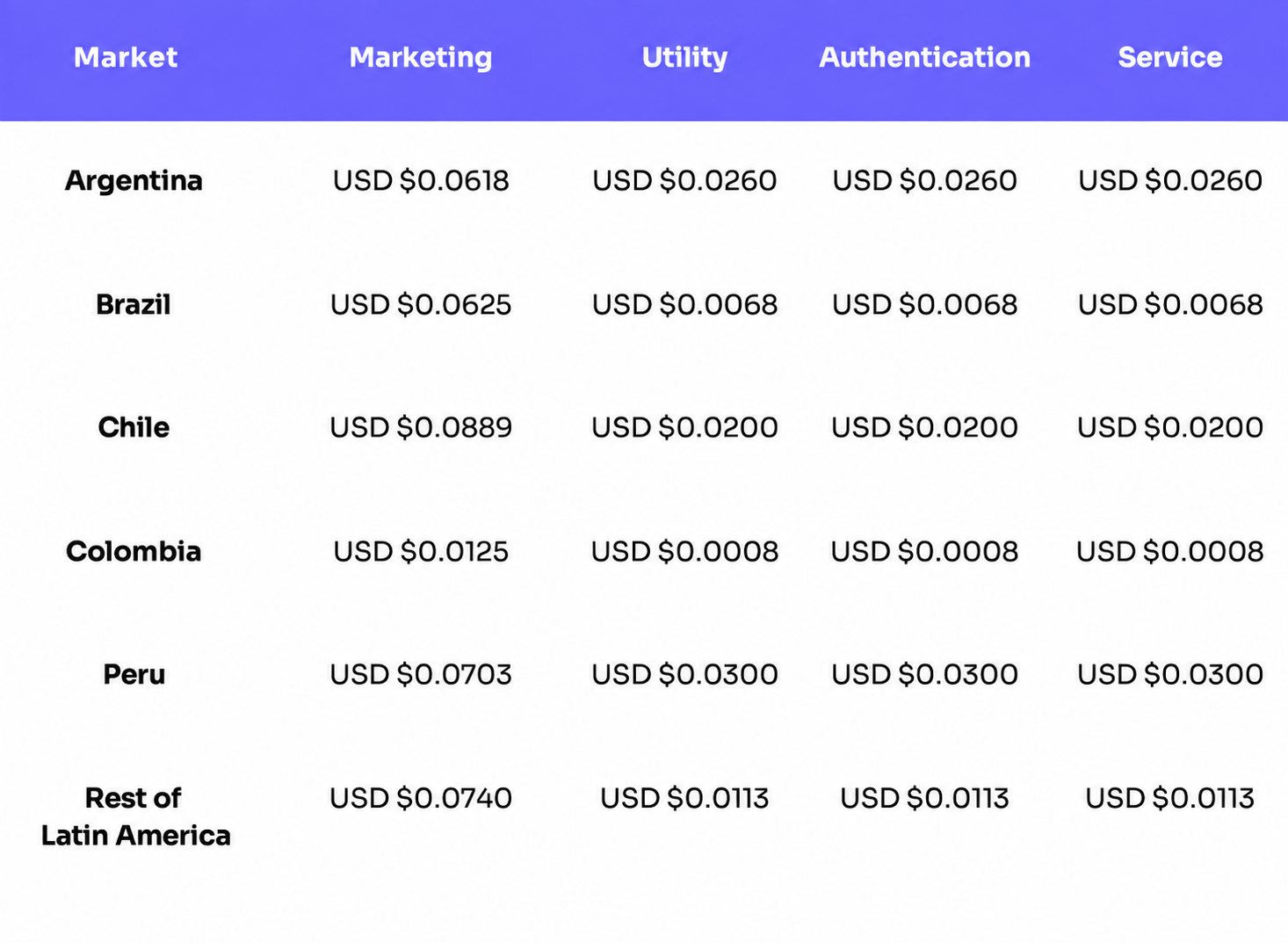
In Latin America, the impact depends on the country. In some markets, such as Colombia, the cost for utility, authentication, and service messages is very low. In others, such as Argentina, Chile, or Peru, service messages are at a higher rate.
For the markets that Meta groups as Rest of Latin America, the rate is USD $0.0740 for marketing and USD $0.0113 for utility, authentication, and service.

What does this mean in practice?
The most important change isn't just the increase in some categories. The key point is that service messages now have a defined price.
Previously, in the table effective as of July 1, 2026, the Service column was listed as n/a for Mexico and other Latin American markets.
Starting October 1, 2026, those messages now appear with a rate in the new table. For Mexico, they are set at USD $0.0085 per message; for the Rest of Latin America, at USD $0.0113.
In simple terms:
If a company uses WhatsApp for customer service, support, chatbots, or conversational agents, each response sent by the company may have a greater impact on operating costs.
Therefore, preparation should focus on reviewing volume, reducing unnecessary messages, and optimizing conversational flows.

Why does it matter for companies with chatbots or agents?
Because chatbots and conversational agents often send multiple messages within a single conversation.
For example:
- greeting
- intent confirmation
- follow-up question
- options
- data validation
- final confirmation
With the new model, every message sent by the company can matter more.
That is why it is not just about paying more. It is about reviewing whether each message truly adds value.

How to prepare
1. Measure how many messages your operation sends
Identify:
- how many messages the company sends per month
- how many are service messages
- how many are utility messages
- which flows send the most messages
- which clients or processes generate the most consumption
Without measurement, it is difficult to estimate the impact.
2. Identify the most expensive flows
Review especially:
- support flows
- follow-ups
- automated campaigns
- reminders
- confirmations
- bots with many short responses
- conversations with many steps
The goal is to find where to optimize.
3. Reduce unnecessary messages
If a flow uses five messages to say something that can be resolved in two, it should be adjusted.
Before:
“Hello.”
“Thanks for reaching out.”
“We’ll help you with your request.”
“First, we need some information.”
“Please share your customer number.”
Better:
“Hello, thanks for reaching out. To help you with your request, please share your customer number.”
Less friction, fewer messages, and a better experience.
4. Use ChatWeb when it makes sense
WhatsApp will remain important, but not everything has to live there.
For frequent, informational, or low-value inquiries, it may be better to move traffic to ChatWeb.
WhatsApp can be reserved for higher-intent conversations, important follow-ups, or cases where the user truly needs that channel.
5. Review the profitability of each solution
Every company should compare:
- what they pay today
- what they could pay with the new model
- what value WhatsApp generates
- which conversations are worth keeping there
- which workflows can be optimized
- which workflows can be moved to another channel
The key question is:
Which conversations justify that cost?
Quick summary
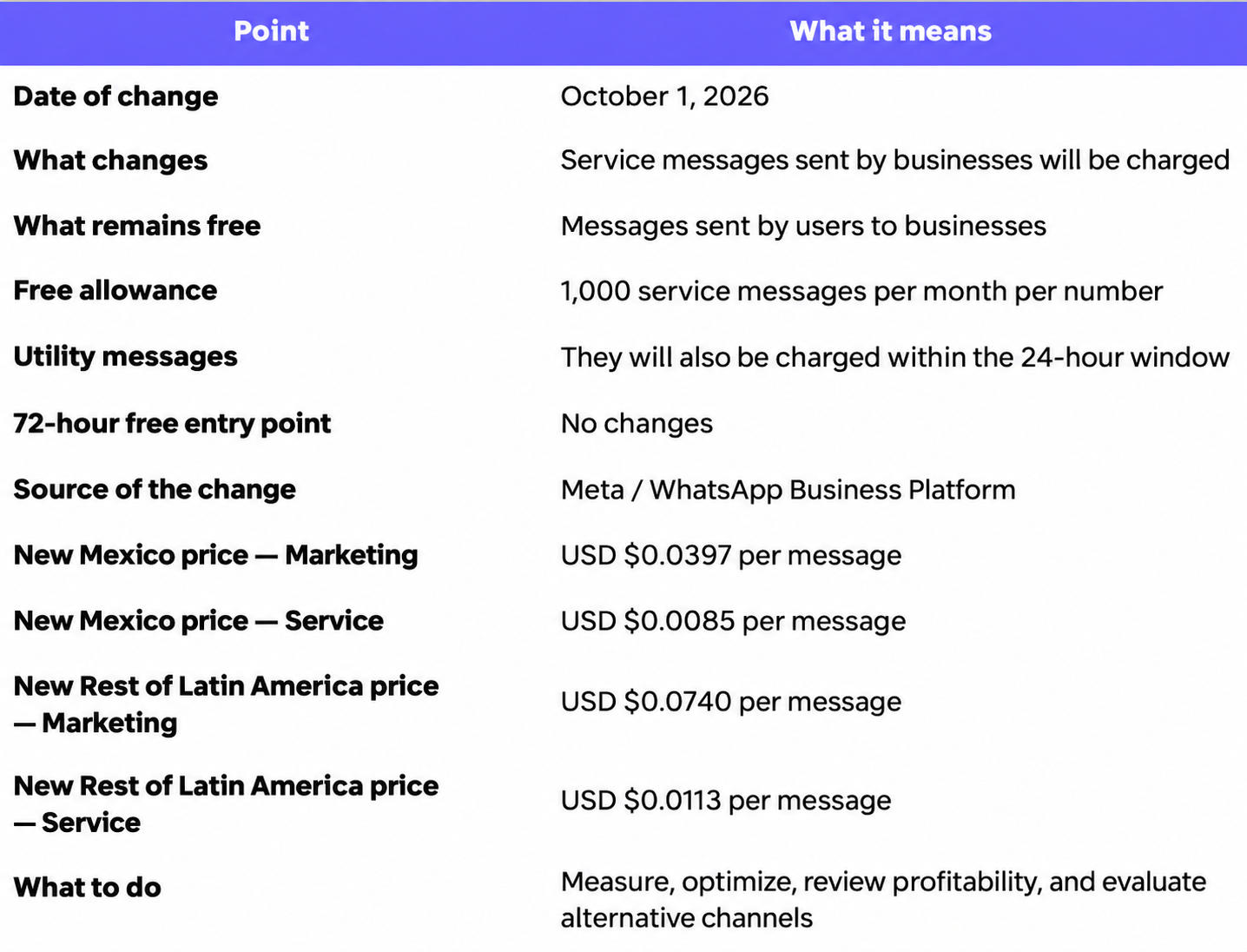
Conclusion
The pricing changes for WhatsApp Business Platform do not mean that WhatsApp is no longer useful. It means that companies will need to use it more strategically.
Starting October 1, 2026, service messages sent by companies will be subject to new billing rules. This may particularly impact operations involving chatbots, conversational agents, automated support, or high message volumes.
The best way to prepare is to review consumption, identify costly flows, reduce unnecessary messages, evaluate ChatWeb where it makes sense, and analyze the profitability of each solution.
WhatsApp will remain a powerful channel. But now, every message must have more intention, clarity, and value.
Sources:
- Meta / WhatsApp — Platform Pricing
https://whatsappbusiness.com/es-la/products/platform-pricing/ - Gupshup — Service Messages Pricing Oct. 2026
https://support.gupshup.io/hc/en-us/articles/62362400519705 - Twilio — Changes to WhatsApp Pricing
https://help.twilio.com/hc/en-us/articles/30304057900699 - Twilio — WhatsApp Pricing Update July 2025
https://www.twilio.com/en-us/changelog/meta-is-updating-whatsapp-pricing-on-july-1--2025 - Gupshup Docs — WhatsApp Business Platform Pricing Updates
https://docs.gupshup.io/docs/pricing-updates-on-the-whatsapp-business-platform - Twilio — WhatsApp Message Costs
https://help.twilio.com/articles/360037672734 - Courier — WhatsApp Pricing Changes Oct. 2026
https://www.courier.com/blog/whatsapp-pricing-changes-october-2026


