
Más publicaciones


WhatsApp API: differences with WhatsApp Business


Learn the differences between WhatsApp, WhatsApp Business, and WhatsApp API to choose the best option for your company.
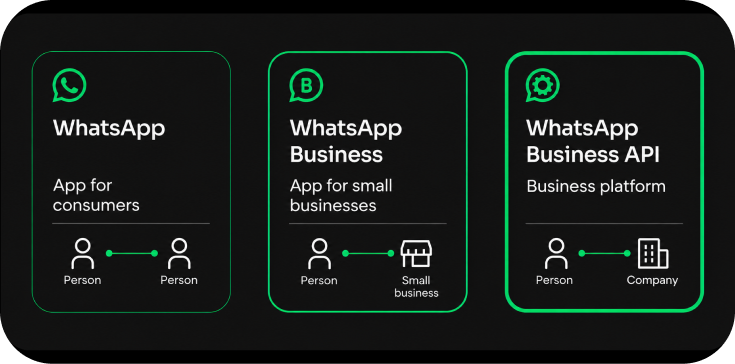
Choosing between WhatsApp, WhatsApp Business, and WhatsApp API can feel confusing at first.
They all use the same channel: WhatsApp.
But they are not designed for the same purpose.
One is for personal conversations.
Another helps small businesses provide better customer support.
And the third allows companies to connect WhatsApp with CRMs, automations, chatbots, conversational agents, and customer service platforms.
For Marketing, Sales, and Customer Service teams, understanding this difference is key. It is not just about “having WhatsApp,” but about choosing the right level based on message volume, type of operation, and the level of automation the company needs.
What is WhatsApp for consumers?
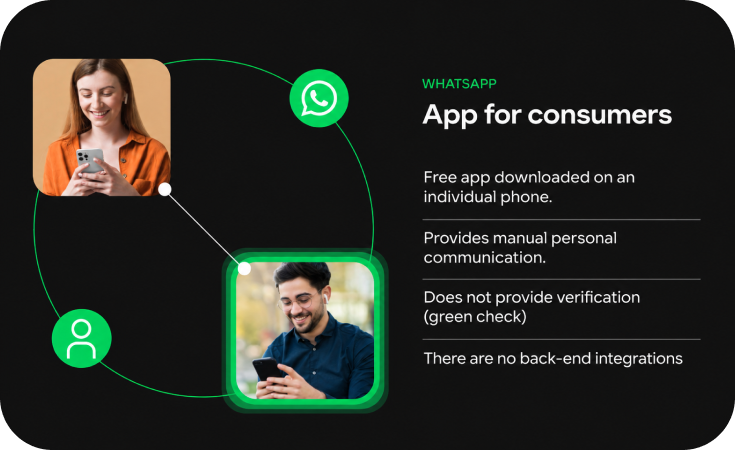
WhatsApp for consumers, also known as personal WhatsApp, is the app most people use every day.
It is designed for personal communication:
- messages with friends and family
- voice calls
- video calls
- sending photos, videos, and documents
- personal groups
- voice notes
It is simple, free, and very easy to use.
However, it is not designed to manage business conversations. It does not allow multiple agents to support customers at the same time, connect a CRM, automate advanced flows, or measure commercial conversations.
That is why, although many companies start by using personal WhatsApp, it is not the best option for growth.
What is WhatsApp Business?
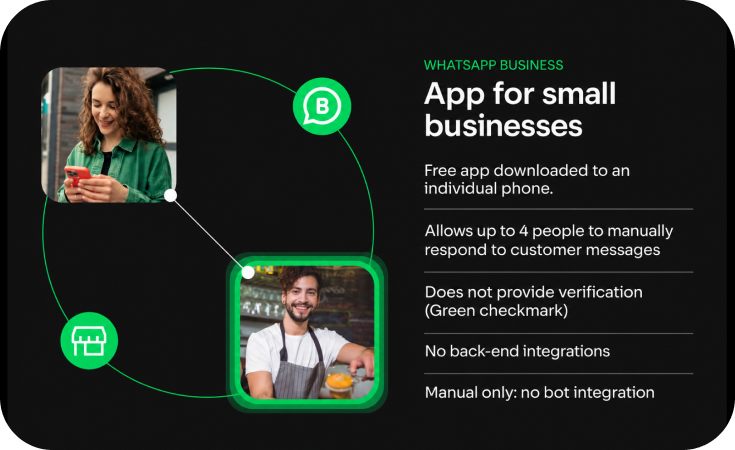
WhatsApp Business is an app designed for small businesses that need a more professional presence on WhatsApp.
It allows you to create a business profile with information such as:
- company name
- address
- business hours
- website
- business description
- product or service catalog
It also includes useful tools such as:
- quick replies
- greeting messages
- away messages
- labels to organize conversations
- basic catalog
- direct link for customers to start a chat
For an SMB, clinic, local store, restaurant, or business with low to medium message volume, WhatsApp Business may be enough.
But it has limits.
When the business starts receiving many messages, needs multiple advisors, wants to automate sales, or connect WhatsApp with marketing campaigns, the app can fall short.
That is where the WhatsApp API comes in.
What is WhatsApp API?
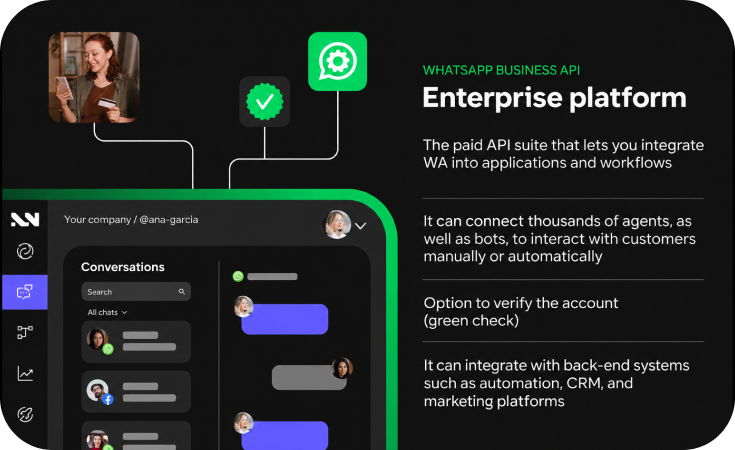
The WhatsApp API, also known as WhatsApp Business API or WhatsApp Business Platform, is the enterprise version of WhatsApp for companies that need to operate at scale.
It does not work like a traditional app installed on a phone. It works through a connection between WhatsApp and an external platform.
This allows companies to use WhatsApp inside tools such as:
- CRM
- sales systems
- customer service platforms
- chatbots
- AI agents
- ecommerce
- ERPs
- marketing tools
- payment systems
- analytics dashboards
-
In other words, the WhatsApp API allows companies to turn WhatsApp into a channel connected to business operations.
Main differences between WhatsApp, WhatsApp Business, and WhatsApp API
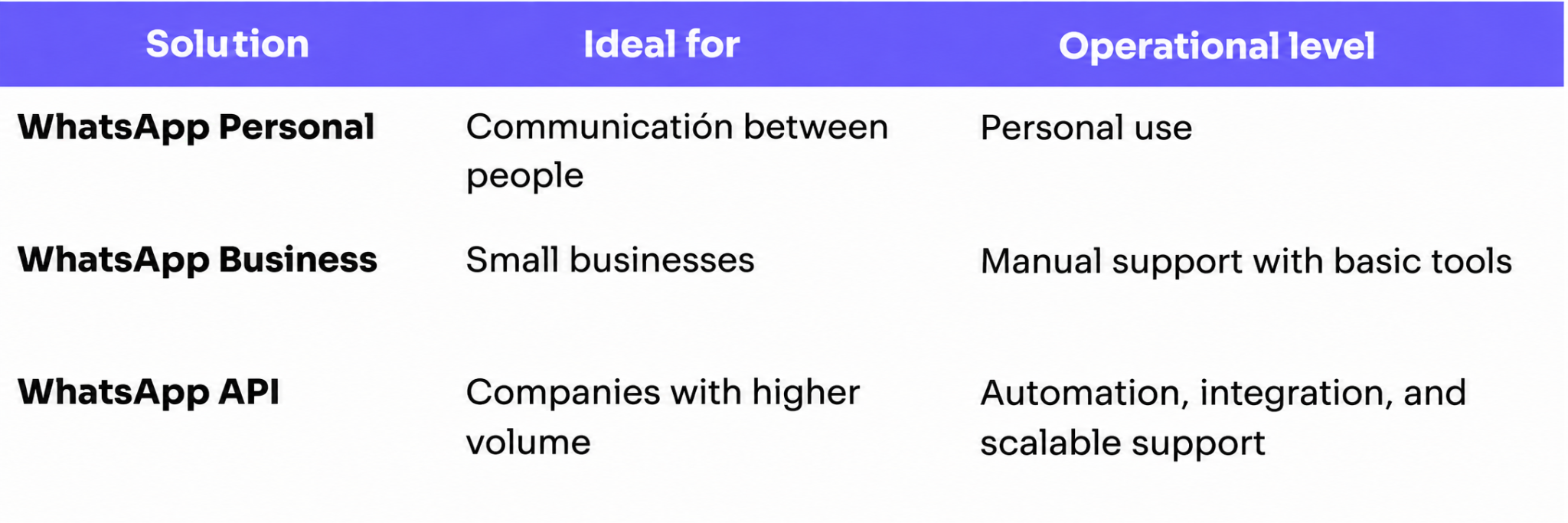
The main difference is scale.
Personal WhatsApp is for talking.
WhatsApp Business is for providing better support.
WhatsApp API is for operating WhatsApp as an enterprise channel.
Benefits of using WhatsApp API
The WhatsApp API offers important benefits for companies that want to scale customer service, marketing, and sales.
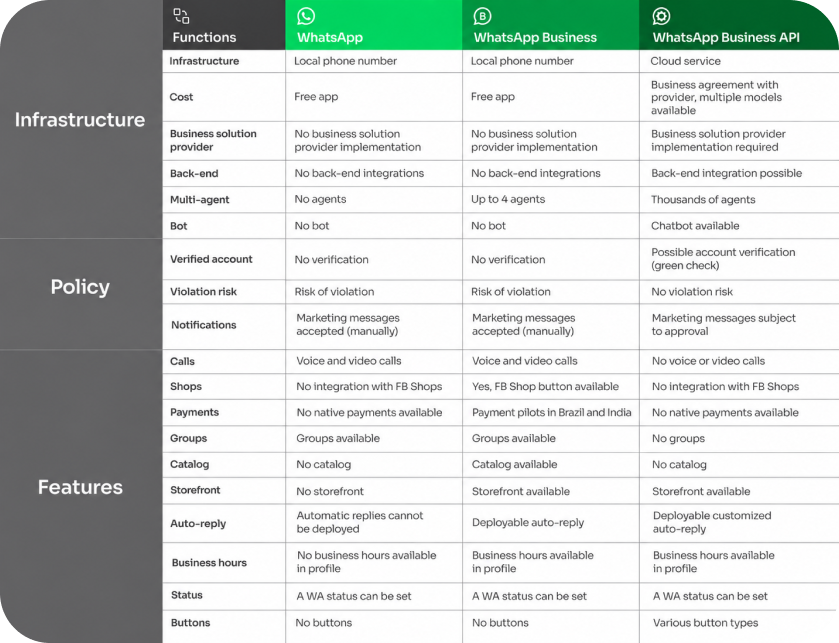
Multi-agent support
It allows different team members to manage conversations from a connected platform, without depending on a single phone.
Conversational automation
The company can create automated flows to answer frequently asked questions, qualify prospects, schedule appointments, send reminders, or follow up.
CRM integration
One of the biggest advantages is connecting WhatsApp with a CRM to record contacts, opportunities, conversation history, and sales process stages.
Chatbots and conversational agents
With the API, WhatsApp can be integrated with chatbots or AI agents to support customers, answer questions, escalate cases, and assist sales or support processes.
To better understand the potential of this channel, you can read our guide on WhatsApp chatbots for companies.
Metrics and control
The API provides greater visibility into conversations, response times, message volume, campaigns, and results.
When should you use WhatsApp API?
The WhatsApp API makes sense when the company has already outgrown the limits of the WhatsApp Business app.
For example, when it needs to:
- manage a high volume of messages
- connect WhatsApp with a CRM
- automate lead follow-up
- run conversational campaigns
- integrate chatbots or AI agents
- have multiple advisors handling conversations
- measure marketing and sales results
- connect payments, appointments, or internal systems
For Marketing teams, the API is especially useful because it turns campaigns into conversations.
A user can arrive from an ad, landing page, or form, and then receive follow-up through WhatsApp in a more organized way.
This connects very well with solutions like AI Marketing & Sales, where AI helps qualify prospects, follow up, and convert opportunities.
What does Facebook Business Manager have to do with it?
To activate an enterprise solution with WhatsApp API, the company usually needs to have its Meta environment configured.
Many teams still know it as Facebook Business Manager, although today it is usually managed through Meta Business Manager or Meta’s business portfolio.
This environment allows you to manage assets such as:
- company
- ad accounts
- users
- permissions
- phone number
- WhatsApp Business account
- business verification
Having this configuration in order helps make the WhatsApp API activation process clearer and more professional.
If your team is ready to move forward, check out our guide on how to access the WhatsApp Business API. There, we explain the requirements, steps, and key points to activate WhatsApp as an enterprise channel.
Working with a WhatsApp Business Platform provider
Many companies access the WhatsApp API through a specialized platform or provider.
This allows companies to operate WhatsApp with:
- multi-agent inbox
- automation
- chatbots
- AI agents
- integrations
- reports
- escalation rules
- technical support
The provider helps connect WhatsApp with the company’s real operation.
In the case of Nerds.ai, the Nerds.ai Platform connects channels, workflows, AI agents, data, and human teams to turn conversations into actions.
Common mistakes when choosing WhatsApp for business
Using personal WhatsApp for everything
It may work at first, but it is not recommended for a serious commercial operation.
Believing WhatsApp Business is enough to scale
The app helps small businesses, but it has limits when there is high volume, multiple agents, or a need for integrations.
Activating WhatsApp API without a strategy
The API does not solve everything by itself. First, you need to define use cases, flows, owners, and metrics.
Not connecting CRM or data
If WhatsApp remains isolated, much of its commercial value is lost.
Automating without a human option
Chatbots and agents should help, not block. There should always be a path to escalate to a person.
Frequently asked questions about WhatsApp API
What is WhatsApp API and what is it for?
The WhatsApp API allows companies to connect WhatsApp with external platforms to automate conversations, support customers, integrate CRM, use chatbots, and operate messaging at scale.
What is the difference between WhatsApp Business and WhatsApp API?
WhatsApp Business is an app for small businesses. WhatsApp API is an enterprise solution that enables integrations, automation, multi-agent support, and larger-scale operations.
Do I need Facebook Business Manager to use WhatsApp API?
Yes. Usually, you need to have Meta’s business environment configured, previously known as Facebook Business Manager, to manage the WhatsApp Business account and related assets.
Is WhatsApp API useful for marketing?
Yes. It can be used for lead follow-up, conversational campaigns, reminders, appointment scheduling, prospect nurturing, and commercial automation.
Can I use chatbots with WhatsApp API?
Yes. One of its main advantages is that it allows the integration of chatbots, conversational agents, and automated flows.
Conclusion
Personal WhatsApp, WhatsApp Business, and WhatsApp API do not compete with each other. Each one responds to a different stage.
Personal WhatsApp is for communication between people.
WhatsApp Business helps small businesses provide better support.
WhatsApp API allows companies to operate WhatsApp at scale with automation, CRM, chatbots, AI agents, and metrics.
For Marketing teams, the difference matters: if WhatsApp is already part of your campaigns, follow-up, or sales process, the API can help turn that channel into a more professional, measurable, and scalable operation.
At Nerds.ai, we help companies operate WhatsApp as a channel connected to marketing, sales, customer service, and automation.
Explore the Nerds.ai Platform, learn about our AI Marketing & Sales solutions, or schedule a demo to design your WhatsApp API strategy.


